NASA’s Curiosity rover marked 5,000 Martian days on Mars on Aug. 29, 2026, while crossing an elevation milestone of one vertical kilometer above its landing site on the floor of Gale crater.
Mission updates published by NASA confirmed that the 1,000-meter climb—roughly 0.62 miles—exceeds previous Mars rover ascents, including the Spirit rover's 106-meter climb up Husband Hill in August 2005. Because a Martian sol lasts 24.6 hours, the 5,000-sol operational milestone corresponds to more than 5,137 days on Earth.
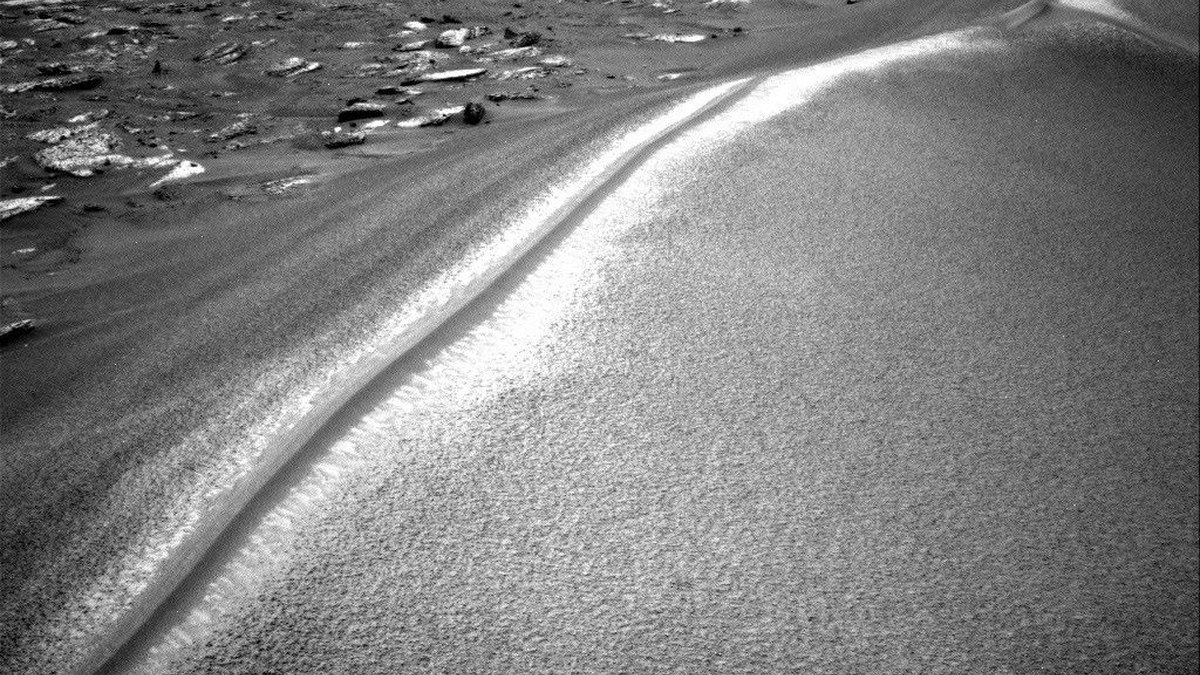
Scientists directed the rover toward a large, wind-formed sand ripple named Chocolatal located on the slopes of Mount Sharp. NASA researchers are examining whether the structure classifies as a transverse aeolian ridge, a landform oriented perpendicular to local prevailing winds. Orbital imaging has tracked similar features across Mars, but Chocolatal sits at a higher elevation, prompting tests to determine its grain sizes, sediment layering, and structural stability.
Operators drove Curiosity’s wheel directly into Chocolatal before backing away slightly, opening a trench for contact instruments to analyze subsurface material. Earlier in the route, the rover deployed its ChemCam Laser Induced Breakdown Spectroscopy tool against light-toned bedrock and rocks bearing thick, dark coatings, while Mastcam captured mosaics of layered buttes.
Science instruments during the Sol 5000 planning cycle examined the newly excavated trench. Curiosity scheduled Mars Hand Lens Imager mosaics across the trench wall to check for sediment stratification, naming the mosaic series in honor of the late planetary scientist Paul Geissler. The rover also slated Alpha Particle X-ray Spectrometer surface and atmospheric measurements, ChemCam scans on Chocolatal's raised crest, and Navcam dust-devil surveys across the terrain.