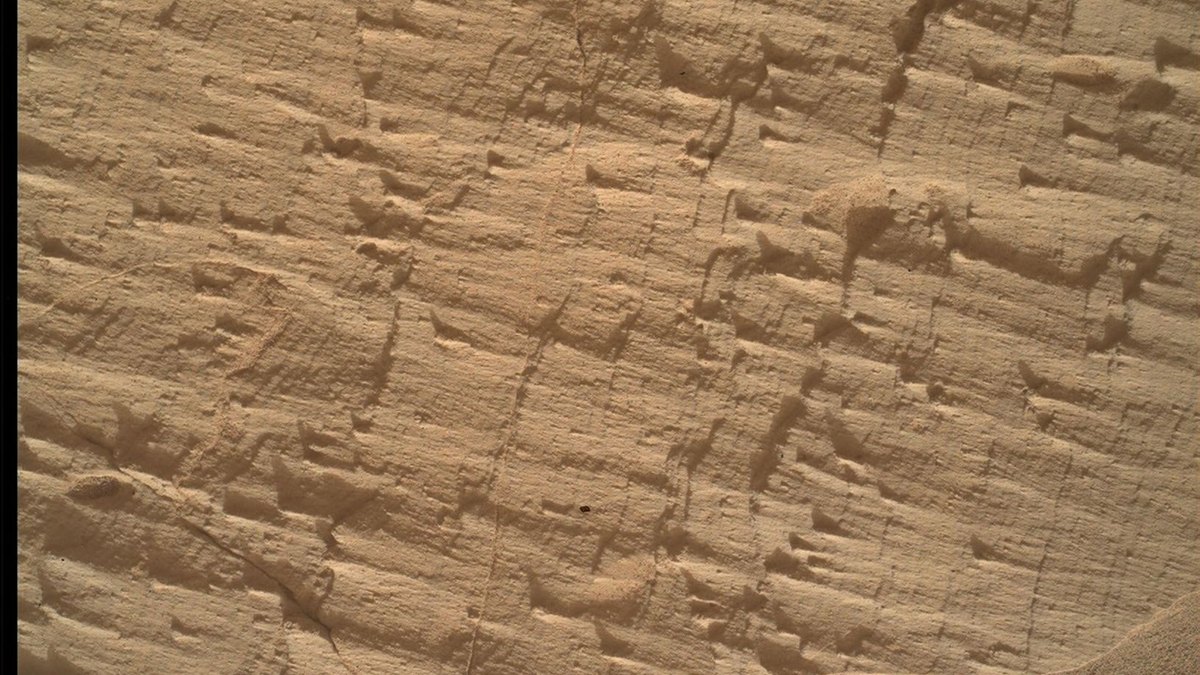
NASA’s Curiosity rover climbed atop a vertical exposure at Cerro Paine Grande on Mars, parking at an approximate 24-degree tilt to conduct contact science on a suspected erosional supersurface. The agency reported that the parking posture approached the mission’s record contact science tilt of 27 degrees.
Planetary scientists are investigating the feature in Gale crater to examine a discontinuity where a net depositional environment shifted to net erosion before deposition resumed. According to NASA, early observations showed patterns resembling wind-blown aeolian features alongside lens deposits that appear consistent with flowing water.
Rover planners used Curiosity's Mastcam to capture stereo mosaics of the outcrop's vertical face and a 360-degree panorama from the crest. Instruments on the rover's robotic arm and mast then began analyzing rock layers situated beneath the discontinuity across multiple planning cycles.
Targeted chemical and structural analysis
During the Sol 4968 planning cycle, mission operators directed the APXS, MAHLI, and ChemCam LIBS instruments to examine a light-toned bedrock target named Puyehue. ChemCam LIBS also targeted bedrock blocks named Lago Palena and Piedras Juntas, while APXS measured a sand target called Cormudesi to track compositional consistency along the rover's route.
Bedrock atop the slope on Sol 4972 showed a sharp division between a smooth, light-toned surface and a rougher, darker laminated face. MAHLI, APXS, and ChemCam LIBS analyzed the upper light surface at Sierra de Sangre, while APXS and MAHLI measured the darker face at Laguna del Laja.
Curiosity also documented fine-scale sedimentary structures with a MAHLI mosaic and Mastcam M100 imaging at a target called Longquimay. The rover finished the sequence by taking long-distance ChemCam Remote Micro-Imager mosaics of higher rock layers, measuring atmospheric opacity, and surveying minor atmospheric gas abundances.