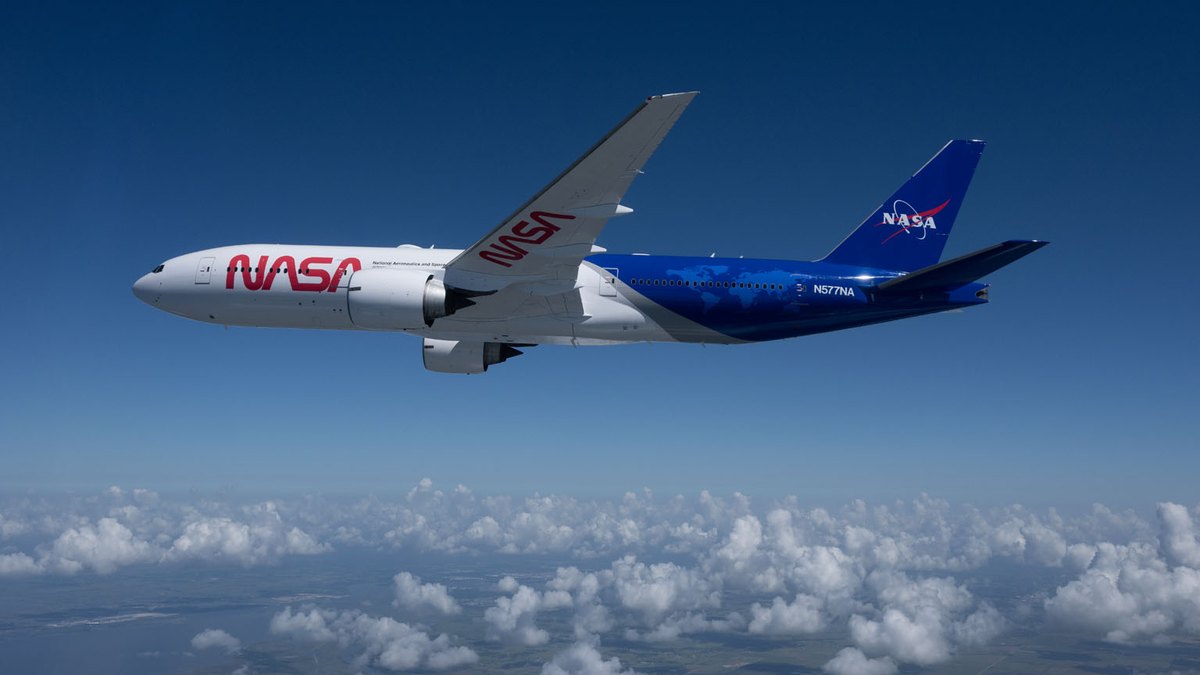
NASA revealed a new paint scheme on its Boeing 777 aircraft in a photograph taken Aug. 11, 2026, marking progress toward deploying the jet as an airborne research platform. NASA reported that the aircraft was acquired to replace the agency’s DC-8 flying laboratory, which concluded its service when the agency retired it in 2024. The newer B777 will extend the operational capabilities previously provided by the retired DC-8.
Langley Research Center in Hampton, Virginia, will host the B777 once operational flights begin. NASA scheduled the aircraft to start operations from the Virginia facility in 2027. The agency designed the aircraft to function as a flying laboratory capable of global reach, providing scientists with an airborne testbed to collect measurements across worldwide flight paths.
NASA outlined several core mission activities for the flying laboratory, focusing on instruments and data systems. The B777 will support sensor development projects alongside satellite sensor calibration work. In addition, flight missions will carry out data product validation to verify the accuracy of scientific datasets generated during airborne and orbital observation efforts.
Field studies conducted aboard the B777 will investigate Earth system processes. NASA said the gathered airborne information will help researchers better understand these natural processes to improve environmental models and aid decision-making. The agency published the photograph of the repainted aircraft on Aug. 18, 2026, attributing the image to photographer James Blair.