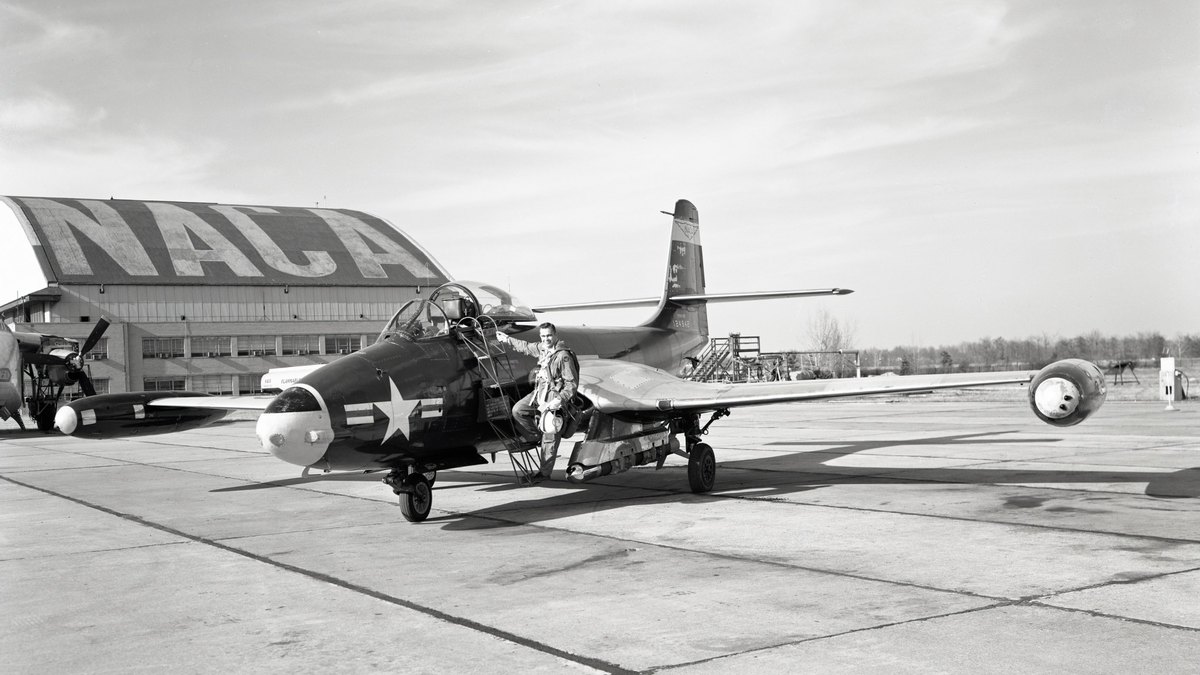
NASA detailed the eight-decade history of flight research conducted at the Glenn Research Center in Cleveland, outlining experimental programs that spanned early jet propulsion, microgravity, and laser communications.
In October 2025, NASA streamlined its aircraft operations by relocating its research fleet from Glenn to the Armstrong Flight Research Center in Edwards, California. Glenn continues to conduct propulsion, icing, and communications research in coordination with Armstrong.
The center began airborne testing during World War II under its original name, the Aircraft Engine Research Laboratory of the National Advisory Committee for Aeronautics. Early pilots Howard Lilly, Joseph Walker, William Swann, and William “Ed” Gough established testing procedures that supported more than two dozen subsequent pilots, including future astronauts Neil A. Armstrong and Fred Haise. These teams evaluated high-altitude engine reliability in the 1940s and later worked to make jet and ramjet engines practical.
For nearly 40 years, Glenn operated a De Havilland DHC-6 Twin Otter to evaluate atmospheric icing conditions and develop data for commercial aviation standards. Glenn also evaluated alternative fuels early in its history, testing a hydrogen fuel system aboard a Martin B-57B Canberra between February and April 1957 to demonstrate operational efficiency.
In 1963, Glenn began high-altitude flights with modified Learjets to assess solar cell efficiency in space-like sunlight conditions. The center also operated a modified DC-9 on parabolic trajectories to test fluids, materials, and combustion in microgravity. Over the Great Lakes, researchers used the Twin Otter and an S-3B Viking to measure water color and map harmful algal blooms across Lake Erie, supplying calibration data for water-quality satellites.
Glenn’s Flight Operations tested laser communications in 2024 using a Pilatus PC-12 NG aircraft, transmitting data over NASA's legacy infrastructure. NASA applied optical communications during the 10-day Artemis II mission, sending data from the Orion capsule to ground stations.