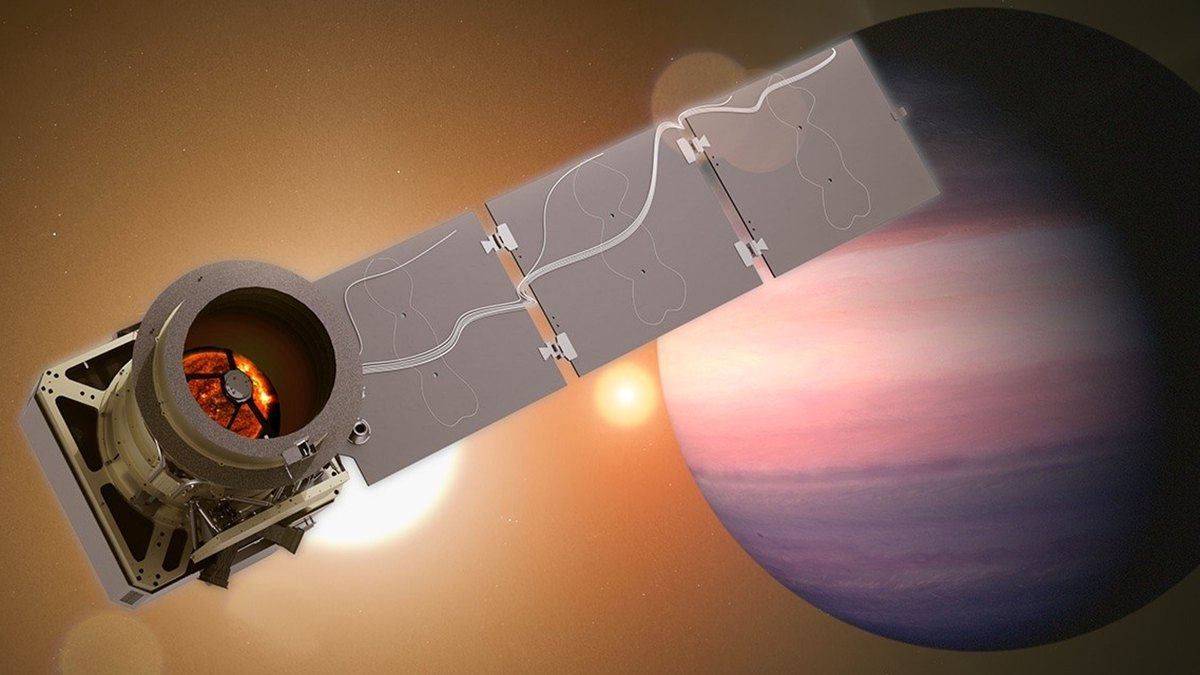
NASA’s Pandora satellite has begun science observations to examine the atmospheres of at least 20 exoplanets and their host stars, the agency announced Tuesday. The mission represents the first satellite launched under NASA’s Astrophysics Pioneers program, an initiative funding fast-paced, low-cost missions that operate with a higher-than-usual tolerance for failure.
Pandora launched into low Earth orbit on Jan. 11. Lawrence Livermore National Laboratory deputy project manager Jordan Karburn confirmed the spacecraft is healthy and its instruments completed commissioning successfully to begin science operations.
Astronomers use transit events—when an exoplanet crosses the face of its host star—to measure starlight filtering through planetary atmospheres. Molecules in the atmosphere absorb specific wavelengths, leaving distinct chemical signatures. However, stellar surface features such as bright faculae and dark spots can distort those signatures, complicating measurements of atmospheric water, hazes, and clouds.
“Pandora’s data will help close a major gap in our knowledge about planets and their host stars because, right now, we can’t be entirely sure how the star’s light affects measurements of what makes up exoplanet atmospheres,” said Elisa Quintana, Pandora’s principal investigator at NASA’s Goddard Space Flight Center.
Pandora addresses this distortion by observing targets simultaneously in visible and infrared light over 24-hour continuous stares. The spacecraft carries an 18-inch (45-centimeter) all-aluminum telescope and a near-infrared detector originally built as a spare for the James Webb Space Telescope. During its year-long primary mission, Pandora will observe at least 20 exoplanets 10 times each.
NASA Goddard leads the mission and supplied the infrared sensor. Lawrence Livermore National Laboratory managed engineering, control electronics, and detector assemblies, while Corning Specialty Materials manufactured the telescope. Blue Canyon Technologies built the spacecraft bus and conducted environmental testing, the University of Arizona directs mission operations, NASA’s Ames Research Center handles data processing, and IPAC at Caltech makes the resulting data available through the NASA Exoplanet Archive.
