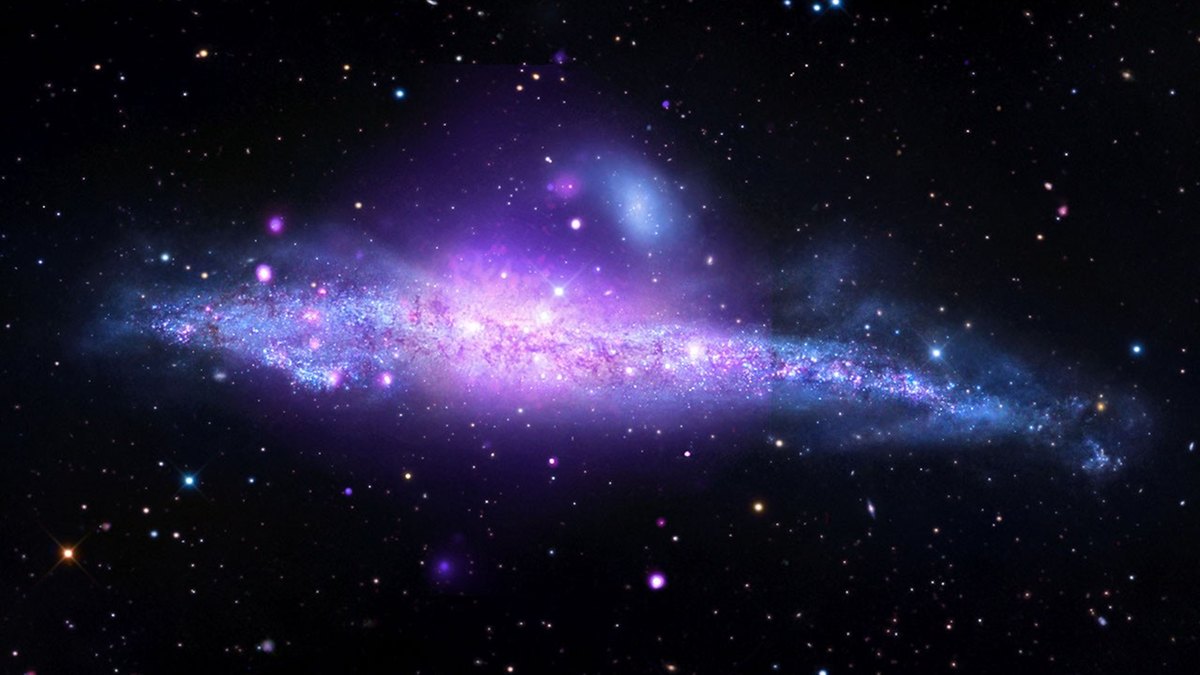
NASA released a gallery of 16 new images on Aug. 25, 2026, pairing decades of Chandra X-ray Observatory data with observations from other space and ground telescopes. The release highlights the structural variety of galaxies, covering spirals, ellipticals, and irregular systems.
Each gallery image merges Chandra's high-energy X-ray data with observations from instruments including NASA's James Webb and Hubble Space Telescopes, the Imaging X-ray Polarimetry Explorer (IXPE), the Neil Gehrels Swift Observatory, and the Nuclear Spectroscopic Telescope Array (NuSTAR). According to NASA, Chandra captures gas superheated to millions of degrees by winds from massive stars, supermassive black hole outflows, and supernova debris.
Spiral galaxies and black hole engines
Face-on spiral galaxies Messier 33 and NGC 3938 display energetic pairs of stars and cosmic explosions along their spiral arms. Barred spirals NGC 1672 and NGC 1385 show central bar structures channeling fuel inward to ignite starbursts, while NGC 4725 reveals star formation triggered by a previous galactic collision. Edge-on views of NGC 4631, known as the Whale Galaxy, and the starburst galaxy Messier 82 show superwinds and giant halos of million-degree gas propelled thousands of light-years into space.
The release also details active galactic nuclei powered by central black holes. Combined Chandra and IXPE data reveal a particle jet extending tens of thousands of light-years from the core of Centaurus A. In Messier 106, black hole jets heat surrounding gas to form distinct spiral arms, while observations of the Sombrero Galaxy (Messier 104) trace a diffuse halo of million-degree gas and hot stellar remnants around its central bulge.
Mergers and gravitational disruptions
Several images record active gravitational transformations. A direct impact in Arp 143 created an expanding ring galaxy and triggered star birth. Violent mergers in NGC 3256 and the dust-shrouded system II Zw 096 showcase chaotic collisions similar to those from the early universe, offering insight into the Milky Way's future merger with Andromeda.
The gallery also includes NGC 1569 as an analog for early starbursts, NGC 660 with stars orbiting over its poles in a rare polar ring, and Messier 90 losing star-forming gas as it travels through the Virgo Cluster.
NASA's Marshall Space Flight Center manages the Chandra program. The Smithsonian Astrophysical Observatory's Chandra X-ray Center oversees science operations from Cambridge, Massachusetts, and manages flight operations from Burlington, Massachusetts.