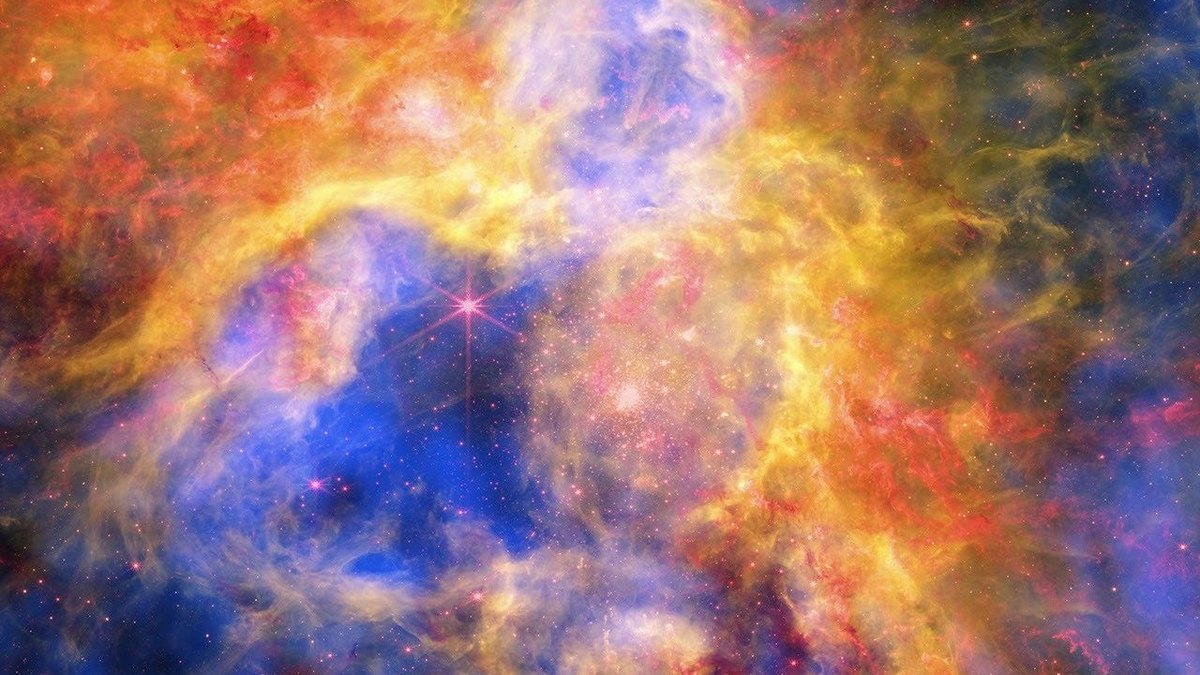
NASA released a composite image of the 30 Doradus star-forming region, also known as the Tarantula Nebula, combining data from three space telescopes to trace energy loss inside the structure. The nebula lies in the Large Magellanic Cloud, a small galaxy located about 160,000 light-years from Earth.
The Chandra X-ray Observatory provided blue data showing gas heated to millions of degrees by shock waves from massive young stars. NASA's James Webb Space Telescope contributed red infrared data that maps cool dust and thousands of young stars. The Hubble Space Telescope provided green optical data, capturing individual stars and warm hydrogen gas.
Researchers expected winds from young, massive stars to heat gas into producing heavy X-ray emissions. However, data published in the Astrophysical Journal revealed far less X-ray-emitting gas inside the nebula than predicted.
The research team used observations from Chandra, Webb, Hubble, and NASA's retired Spitzer Space Telescope to identify three channels of energy loss. Up to half of the hot gas leaks through shell walls in the gas and dust structures. Direct mixing between cold gas near shell walls and hot gas reduces overall temperatures, while direct physical contact conducts heat into cooler material in dense shells.
Jennifer Rodriguez of The Ohio State University led the study. Co-authors included scientists from Columbia University, San Diego State University, the Space Telescope Science Institute, and NASA’s Goddard Space Flight Center. NASA's Marshall Space Flight Center manages the Chandra program, with science operations based at the Chandra X-ray Center in Cambridge, Massachusetts.