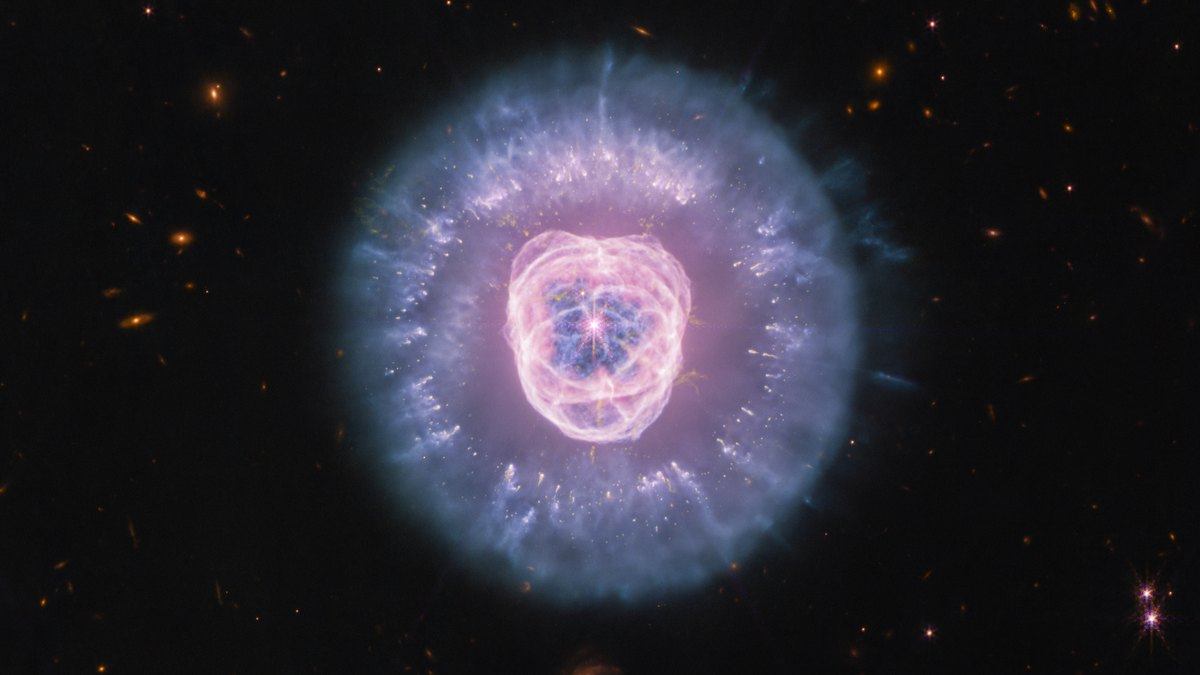
NASA's James Webb Space Telescope has captured high-resolution infrared images of NGC 2392, a planetary nebula nicknamed the Lion Nebula. NASA released the images on Aug. 10, 2026, detailing observations taken with the observatory’s Near Infrared Camera and Mid Infrared Instrument.
Hubble previously observed the target in visible light in 2000. Webb’s infrared instruments provide a clearer view of the nebula, highlighting compact dust clumps and a haze of ionized gas that have taken several thousand years to reach their current structure.
A dying, oxygen-rich star at the center of NGC 2392 powers the nebula's features. Unlike higher-mass stars that end in supernova explosions, this lower-mass star became unstable when core nuclear reactions stopped, pulsating and shedding its outer layers. The remaining white dwarf heats the surrounding space and expands a bubble of ionized gas, destroying dust in its path as it forms the lion's face structure. Stars at this evolutionary stage produce much of the universe's observable dust.
The feature resembling a lion’s mane is the interior of a dust shell illuminated by the central white dwarf. Tufts of material shaped like cometary tails are dense dust clumps that survived the radiation, shielding gas and dust located behind them.
Webb, an international collaboration between NASA, the European Space Agency, and the Canadian Space Agency, captured the nebula in a transient state. Astronomers estimate NGC 2392 will disperse entirely in about 10,000 years as its material continues migrating away from the stellar core.