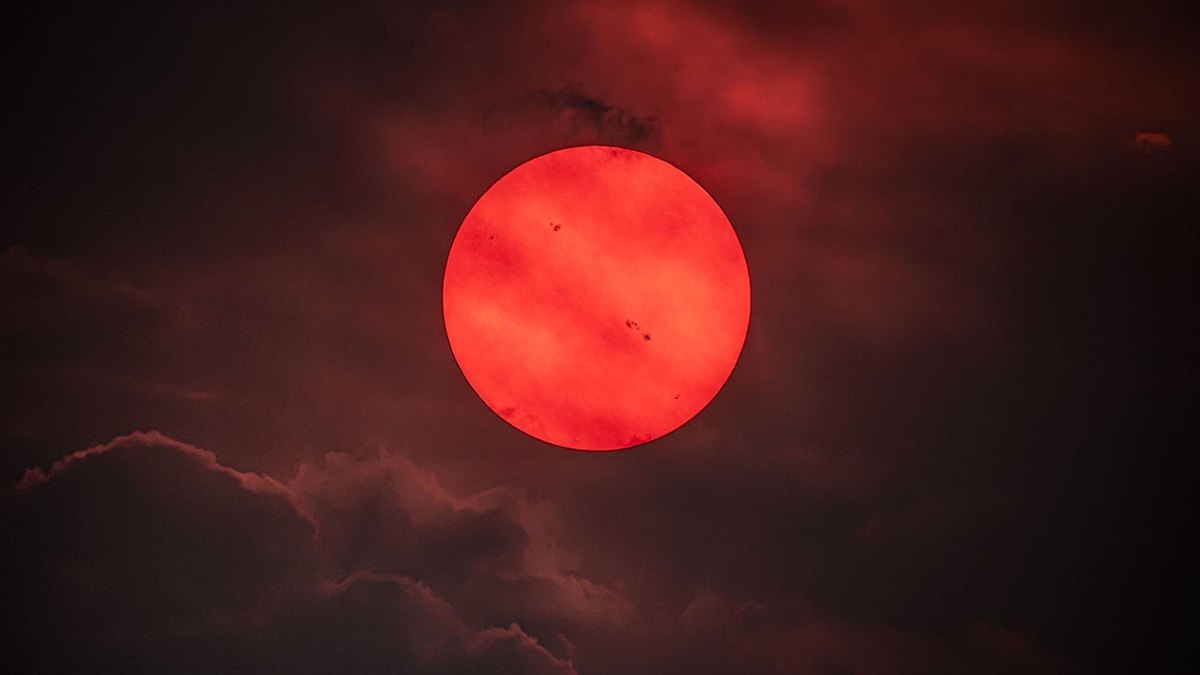
NASA featured a photograph of the Sun appearing as a red disk on July 30, 2026, captured through thick wildfire smoke over British Columbia. Photographer Debra Ceravolo took the picture on July 22, 2026, in the Okanagan region of the Canadian province.
Smoke drifting from wildfires in the Pacific Northwest created a natural solar filter, enabling direct photography of the Sun. NASA explained that tiny particles within the smoke scattered and blocked bluer wavelengths of light. This light scattering left the solar disk dimmer and redder than usual, while making sunsets and sunrises more colorful. The agency added that looking directly at the Sun remains unsafe despite the atmospheric filtering.
The image revealed several sunspots across the solar surface. Positioned just below and right of the center was AR 4493, a giant active solar region and fast-evolving group of sunspots. NASA stated the view resembles what an observer might see from an exoplanet orbiting a red dwarf star.
Astronomers noted that the Sun will naturally turn redder about 6 billion years from now as it approaches its red giant phase. The feature was produced as part of the Astronomy Picture of the Day service, managed by NASA Science Activation and Michigan Tech. Robert Nemiroff, Jerry Bonnell, Keighley Rockcliffe, and Cecilia Chirenti served as authors and editors for the release.
Daily entries in the publication feature different space photographs alongside brief explanations by professional astronomers. Adjacent features in late July included a July 29 report on the Psyche spacecraft receiving a Mars gravity assist, followed by a July 31 image of NGC 4372 and the Dark Doodad.