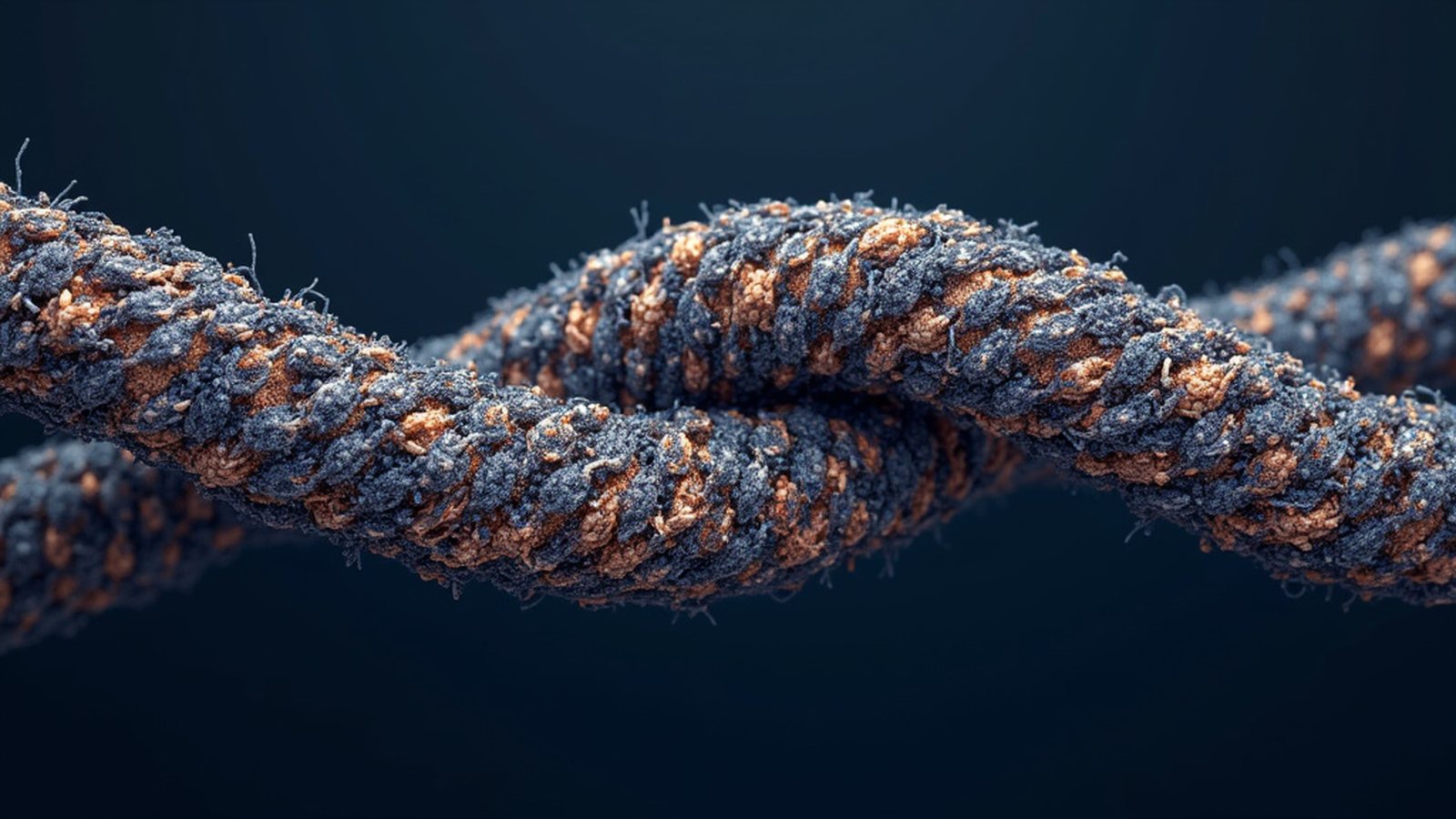
Researchers from Peking University, Tsinghua University, Soochow University, and ETH Zurich have developed fibrous zinc-ion batteries reinforced with an aramid nanofibre skeleton, according to a study published in Nature Communications on August 10, 2026. The architecture addresses mechanical degradation caused by deformation in wearable flexible electronics.
Conventional hydrogel electrolyte-based fibrous batteries suffer from structural mismatches between their soft hydrogel electrolytes and rigid electrodes. When bent or strained, stress concentrations degrade the interface, reducing battery life and performance. To fix this, the research team used wet spinning to incorporate aramid nanofibres simultaneously into both the electrodes and the electrolyte. This shared skeleton aligns the mechanical modulus across the battery structure.
Beyond structural reinforcement, the aramid nanofibres alter anion migration kinetics and the crystalline structure of the hydrogel electrolyte. This modification mitigates common failure modes in deformed batteries, including sluggish ion transport, unwanted byproduct reactions, and uncontrolled zinc dendrite growth.
In testing, the fibrous zinc-ion batteries endured 100,000 deformation cycles at 1 percent strain and a rate of 0.01 percent per second. In subsequent charge and discharge cycling, the cells retained 90.3 percent plus or minus 1.3 percent of their capacity. The team demonstrated practical functionality by weaving the fibrous batteries into an energy storage textile.
The study was authored by lead contributors Yinan Yang, Zhaochang Chen, and Xianda Ma, alongside researchers Gang Xiao, Miaoyi Xu, Zewan Lin, Ziyan Xiong, Xiaoxu Zhao, Bingyun Ma, Haochen Huang, Yanyan Shao, Xuan Zhang, Tao Cheng, Jin Zhang, and Yuanlong Shao. Funding for the project was provided by Chinese state institutions, including the Ministry of Science and Technology of China and the National Natural Science Foundation of China. The authors reported no competing financial interests.
