Most people talk to a chat bot the way they talk to a search box: one question, one answer, move on. These three lines change the shape of the exchange. Watch the video, or read the transcript below it.
The three prompts
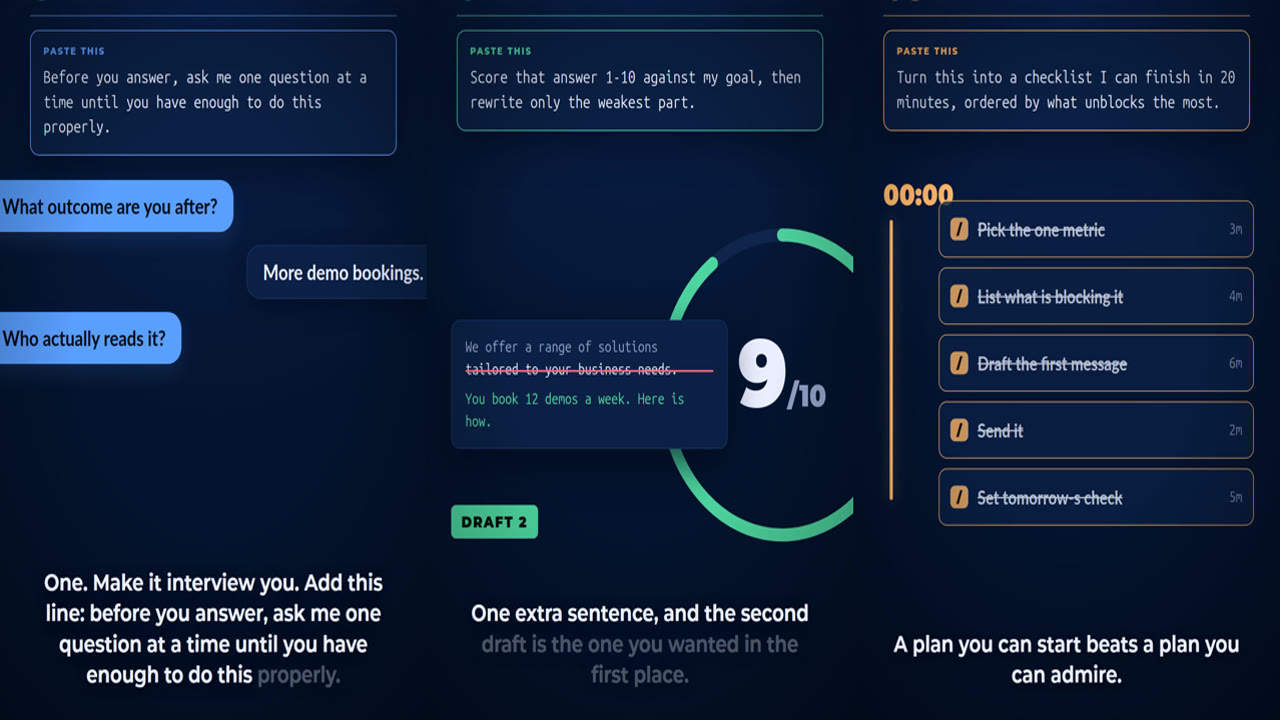
One — make it interview you. Add: “Before you answer, ask me one question at a time until you have enough to do this properly.” It stops guessing, so you stop getting generic answers. This is the same move ChatGPT makes on its own before a deep research run — a clarifying pass that collects your goals and constraints first.
Two — make it grade itself. Add: “Score that answer 1–10 against my goal, then rewrite only the weakest part.” One extra sentence, and the second draft is the one you wanted in the first place. Researchers call the general version of this self-refinement, and measured it improving model output by roughly 20 points on average across tasks.
Three — make it finishable. Add: “Turn this into a checklist I can finish in 20 minutes, ordered by what unblocks the most.” A plan you can start beats a plan you admire. Anthropic’s own prompting guide starts one step earlier still: decide what success looks like before you write the prompt.
Transcript
- 0:00.3
- Most people talk to chat bots like a search engine. These three prompts turn one into a coworker.
- 0:06.3
- One. Make it interview you. Add this line: before you answer, ask me one question at a time until you have enough to do this properly.
- 0:14.7
- It stops guessing, so you stop getting generic answers.
- 0:18.6
- Two. Make it grade itself. Say: score that answer one to ten against my goal, then rewrite only the weakest part.
- 0:26.0
- One extra sentence, and the second draft is the one you wanted in the first place.
- 0:30.7
- Three. Make it finishable. Say: turn this into a checklist I can finish in twenty minutes, ordered by what unblocks the most.
- 0:38.7
- A plan you can start beats a plan you can admire.
- 0:41.9
- More prompts like these at xentir media dot com.
