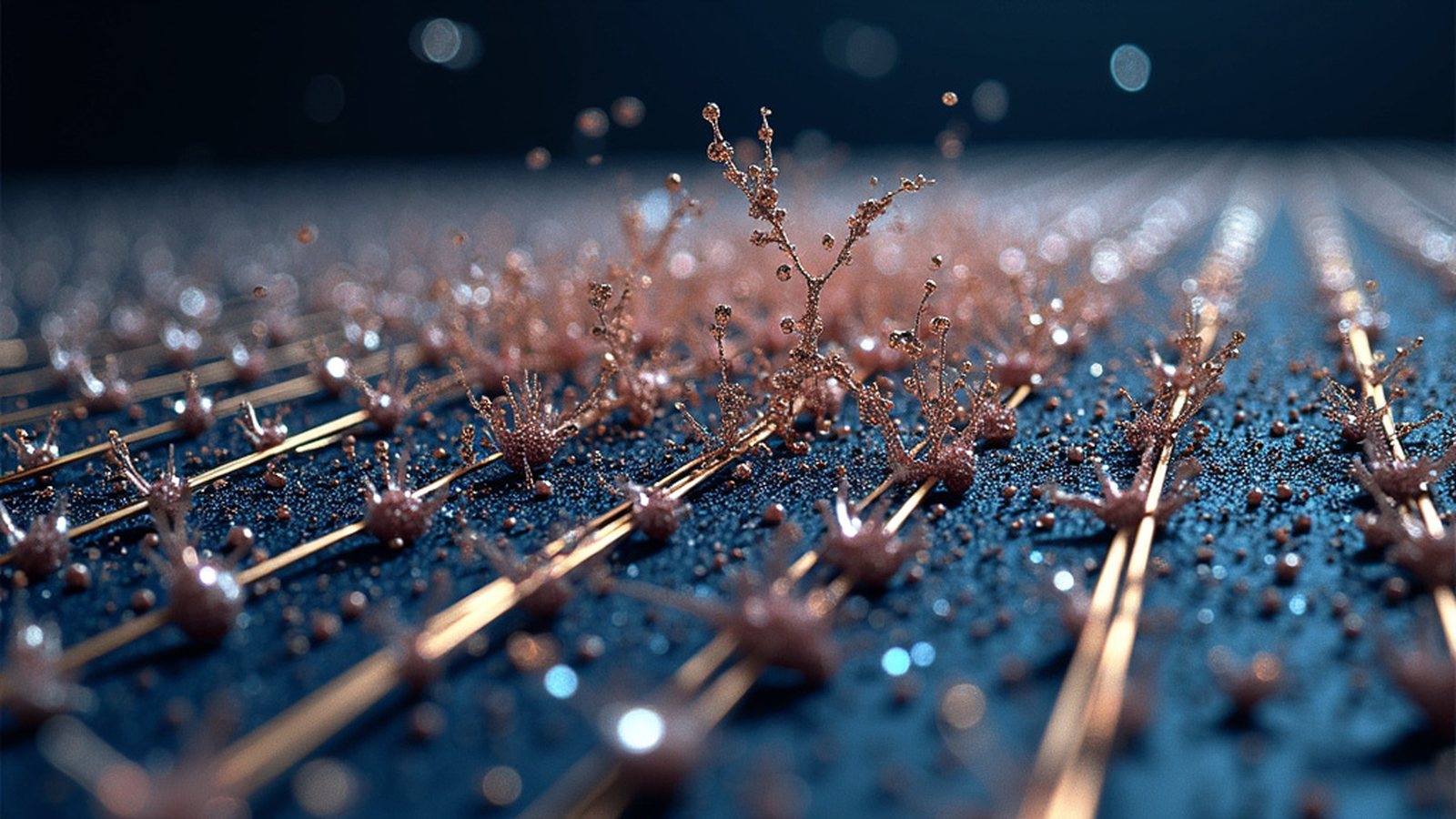
MIT physicists observed how two distinct electron phases emerge and coexist within the rare-earth material erbium tritelluride, according to research published in Nature Physics.
Led by Nuh Gedik, the Donner Professor of Physics at MIT, the researchers examined charge density waves, which occur when electrons spontaneously organize into wave patterns. In erbium tritelluride, a dominant wave forms in one direction when the material is cooled to -8 degrees Celsius. When cooled further to -113 degrees Celsius, a perpendicular subdominant wave appears, producing an atomic checkerboard pattern of coexisting phases.
Gedik and his team analyzed atomically thin sheets of the material synthesized by collaborators at Stanford University. The researchers cooled the samples to about -230 degrees Celsius in Gedik’s laboratory to establish both charge density waves simultaneously. They then disrupted the pattern using an initial laser pump pulse, followed by a high-energy photon probe pulse that ejected electrons. By measuring the energy and momentum of the ejected electrons at varying time intervals, the team tracked how the electronic phases recovered.
Two distinct transitions
The experiments revealed contrasting recovery paths for each phase. The dominant wave reemerged gradually and uniformly across the material, operating as a textbook second-order phase transition. The subdominant wave reformed through isolated pockets that gradually expanded across the material like ice crystals, exhibiting a first-order phase transition.
Study co-author Alfred Zong, an assistant professor at Stanford University who co-led the work as an MIT graduate student, noted that materials hosting multiple coexisting phases represent candidates for replacing silicon in high-performance quantum devices. First author Yifan Su explained that charge density waves provide a simpler collective phenomenon to investigate how multiple electron phases interact compared to complex states like superconductivity.
The study received support from the U.S. Department of Energy, the U.S. National Science Foundation, and the Gordon and Betty Moore Foundation’s EPiQS Initiative.
