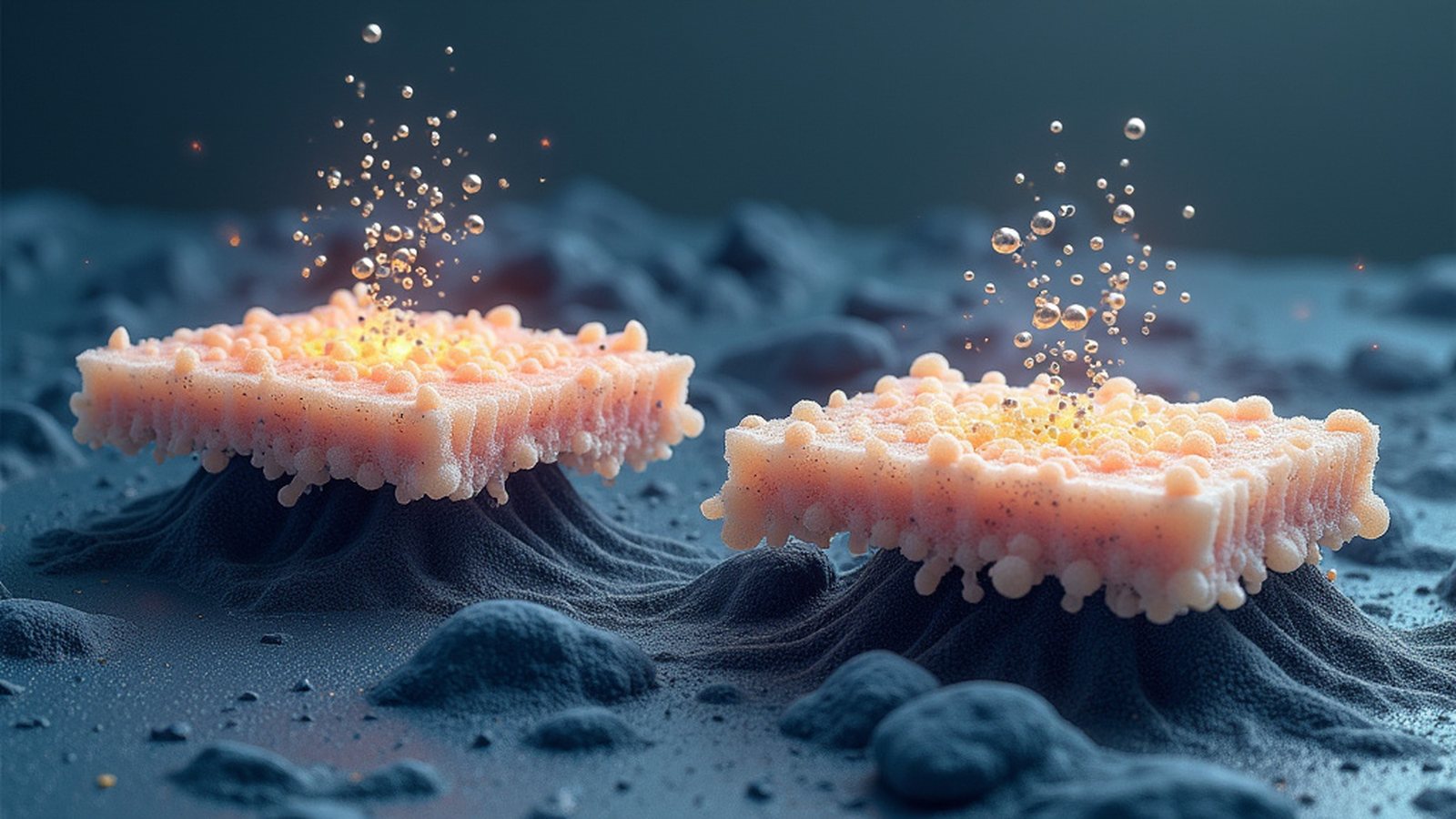
Researchers engineered rhodium-decorated violet and black phosphorus heterostructures to drive vapor-fed photocatalytic hydrogen production, reaching a generation rate of 5218.7 μmol g−1 h−1 under simulated sunlight. The study, published in Nature Communications, shows that the vapor-fed design produces hydrogen at roughly 2.4 times the rate of conventional liquid–solid setups.
The catalyst relies on integrative dual-electric fields formed by combining a cooperative phase with a fringing electric field across two-dimensional phosphorene. This dual-electric field generates an intrinsic charge driving force and establishes charge ordering along the edges of the material.
Using a vapor-fed gas–solid reaction environment minimizes interfacial diffusion barriers and avoids solvent shielding. That setup lets the electric field guide photoelectrons directly to edge-located rhodium active centers to react with water molecules, increasing polarization and lowering the water dissociation barrier at the interface.
Scientists from Dongguan University of Technology, Shenzhen University, Xi’an Jiaotong University, RMIT University, Shantou University, and the Dalian Institute of Chemical Physics contributed to the project. Research funding came from several sources, including the National Key Research and Development Project and the National Natural Science Foundation of China.