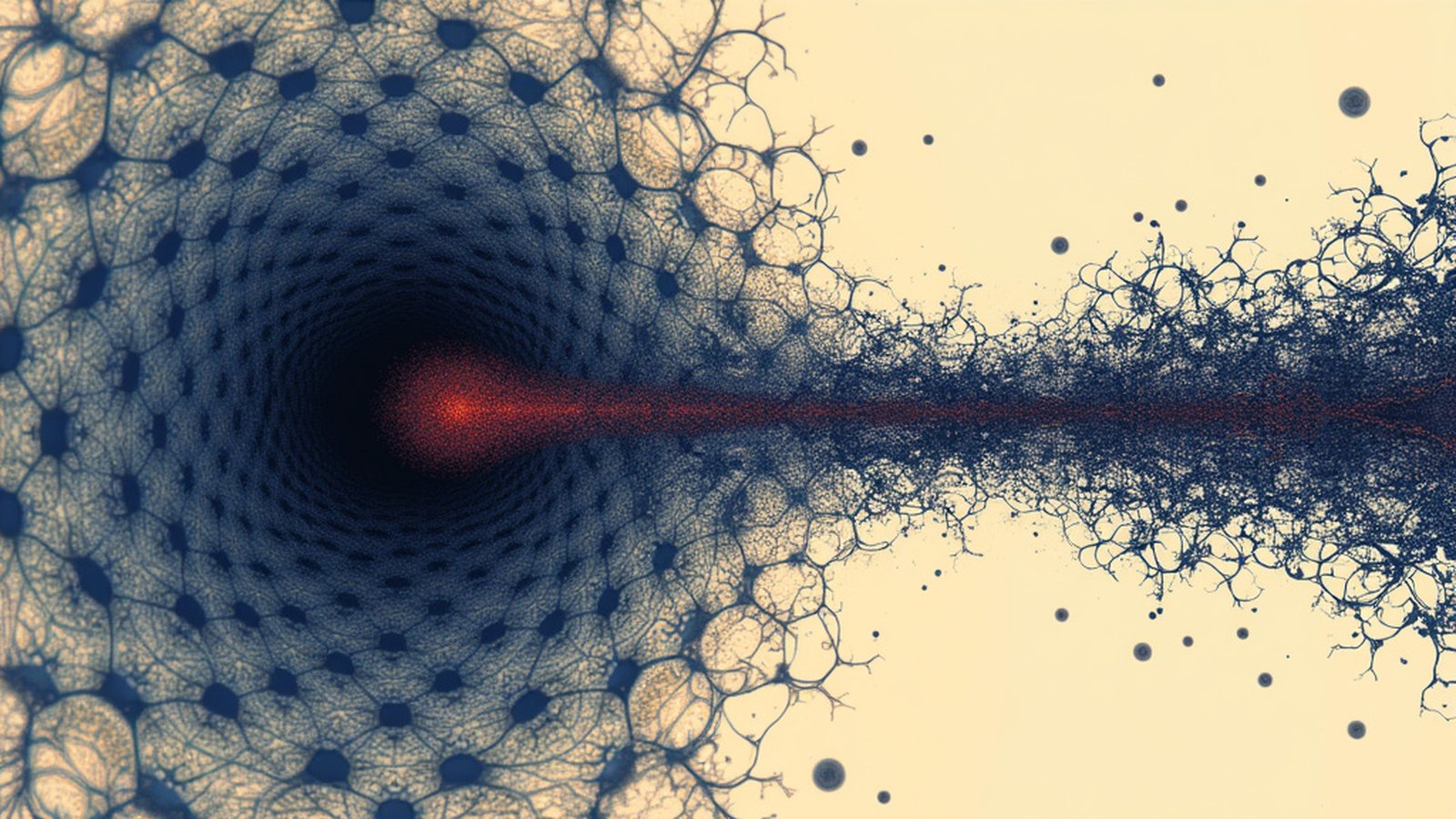
Researchers at Fudan University and ShanghaiTech University built an artificial intelligence framework that designs fibrous network materials while accounting for real-world manufacturing constraints. Reporting in Nature Communications on July 30, 2026, the team introduced the Regular Fibrous Network Framework to connect digital topology, mechanical prediction, and physical production.
The system addresses a fundamental challenge in material design, where topology, mechanical behavior, and fabrication rules remain deeply coupled. Within the framework, a Topology-Preserving Network Construction algorithm formalizes Eulerian circuit continuity for single-fiber fabrication. This converts digital topologies into architectures compatible with industrial knitting and three-dimensional printing.
Performance Modeling
To analyze structural behavior, an automated finite-element-analysis pipeline works alongside a physics-inspired graph neural network. Together, they capture nonlinear J-type and C-type load-displacement behaviors under stress. A reinforcement learning module then executes inverse design tasks in minutes. Compared with initial design baselines, the optimized networks demonstrated approximately 50% higher strength and roughly 20% lower mass.
3D Mapping and Testing
Researchers extended the pipeline using QuadriFlow-based surface mapping, which projects optimized two-dimensional network designs directly onto curved three-dimensional geometries. The team validated these designs physically through stereolithography and fused deposition modeling.
Computations for the project ran on the CFFF platform at Fudan University. Authors Yang, Y., Ren, J., Cao, L., and colleagues conducted the work across Fudan University's Department of Macromolecular Science, Shanghai Stomatological Hospital, and ShanghaiTech University. Funding sources included the National Natural Science Foundation of China, the National Key R&D Program of China, the Xiaomi Young Scholar Program, and the Ruiqing Young Scholar Program.
